


As at the 2nd January 2025, Llantrisant Town Ward has an electorate of 3,250. Making it the largest of the 4 Community Council wards. Llantrisant is represented by 4 Community Councillors.
At Borough Council level the ward is represented by 2 members. Cllr Glynne Holmes and Cllr Sarah-Jane Davies
HISTORY
The first residents of the area were the Iron Age dwellers of the Hill fort at Caerau, to the east of the present town. The Romans came later, again with a fort, made from timber. The first Christian settlement in what we now know as the old town of Llantrisant was founded by monks from Llantwit Major in the 6th Century. The earliest known references to Llantrisant by name occur in 1246, and in 1346 the Townsmen of Llantrisant were recognised for their great valour at the Battle of Crecy. Their skill with the longbow was pivotal in the adoption of the weapon by Royal Armies throughout the Middle Ages. A few months earlier the town had been granted its first Charter.
It was the Normans though who built the present church, on the site of the much earlier Celtic Church. The three saints of the Town’s name are Illtyd, Tyfodwg and Gwynno. On top of the hill, the Graig, nearby, is Yr Hen Felin Wynt, the remains of a 14th Century Windmill.
Not much is left of Llantrisant’s Castle, originally built in stone on the site of a wooden fortress by Richard de Clare, Lord of Glamorgan around 1246. Famously used in 1326 as an overnight prison for Edward II, it was reported to be in ruins by the reign of Henry VIII, and all that remains today is a wall of the Raven Tower.
An ancient tradition called Beating the Bounds, where local children are bounced by elders on to the boundary stones of the old borough, still occurs every seven years and has its roots set as far back as the 14th century. The rite was intended as a reminder to each generation of the importance of the borough boundaries. The children in question are held under the arms and the legs, and their backside is bounced on each of the stones of the old borough. It is believed that the Beating of the Bounds started in 1346, when Llantrisant was awarded its Royal Charter. This allowed them the freedom to trade without paying tolls within the boundaries of the former borough.
Llantrisant Common is managed by the Town Trust on behalf of the Freemen of Llantrisant. The Charter granted by Edward III in 1346 allowed the Freemen to graze their cattle and horses on the land. Its 280 acres are also a Site of Special Scientific Interest.
There has been a Royal Mint in the UK for at least 1100 years, but its present location in Llantrisant was opened in 1968, and since 1975 it has been the only site minting our currency in the UK. It’s the largest Mint in Western Europe.
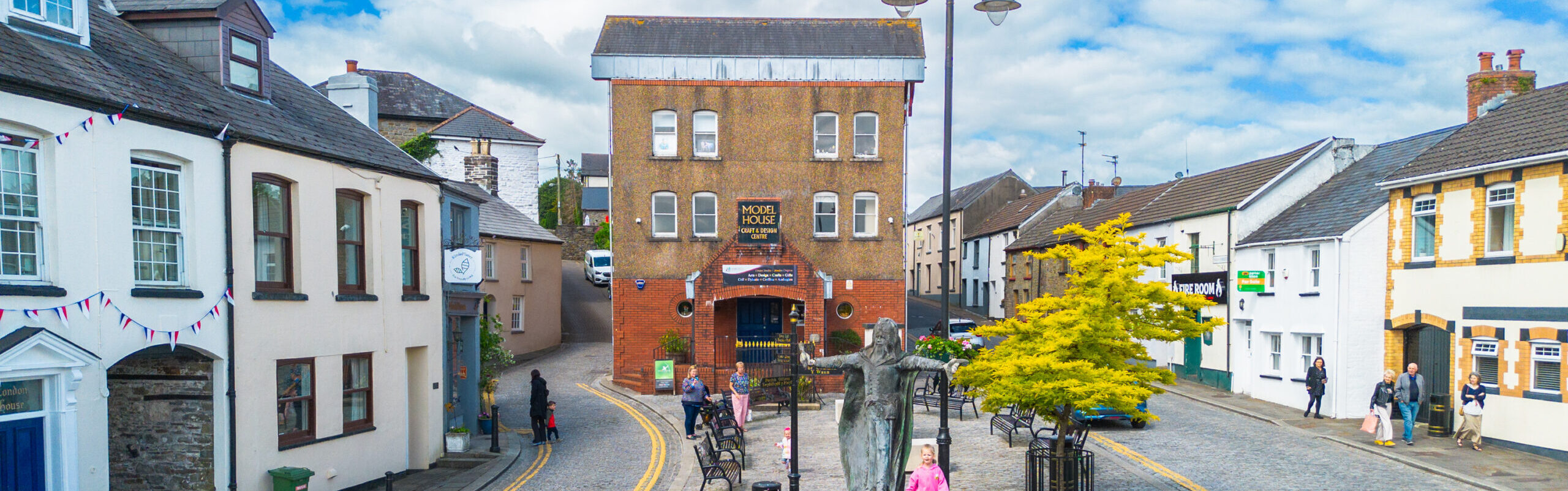
The Model House in the heart of the old Town was opened in 1989 as a craft and exhibition centre. It is built on the site of the first workhouse in Glamorgan opened in 1784. Immediately in front of the Model House is The Bull Ring, which until 1827 was used as a site for bull baiting, once a popular entertainment for Market Day! In the Bull Ring stands a statue to William Price the surgeon, chartist and druid (1800-1893). He was the inventor of legalised cremation in the UK, and was himself cremated at East Caerlan, the highest point to the east of the town, witnessed by over 20,000 people.
Cross Inn
The name Cross Inn first appears in the 1851 Census, reflecting the coaching inn at the cross road linking Llantrisant to Llantwit Fardre and Efail Isaf. The Cross Inn Pub is still a large part of the local community. In 1875 a train station opened and served the local community until 1952. The redundant line has been transformed into a Community Route for pedestrians, cyclists and runners to enjoy.
Rhiwsaeson
The small hamlet of Rhiwsaeson grew around a Flannel Mill which has long since been demolished. The name Rhiwsaeson means “Slope of the Saxon” and the theory is that a battle took place at the site between the Danes and the Saxons. Just above Rhiwsaeson at Caerau is the site of an Iron Age Fort which was probably still in use and defended during the Roman invasion of AD79.
USEFUL CONTACTS